

Leak Detection
Pretoria North
Leak detection Pretoria North homeowners pay for should start at the water meter, not with a chisel. A fifteen-minute meter test shows whether there is a leak at all, before anything is opened.
Request a call-out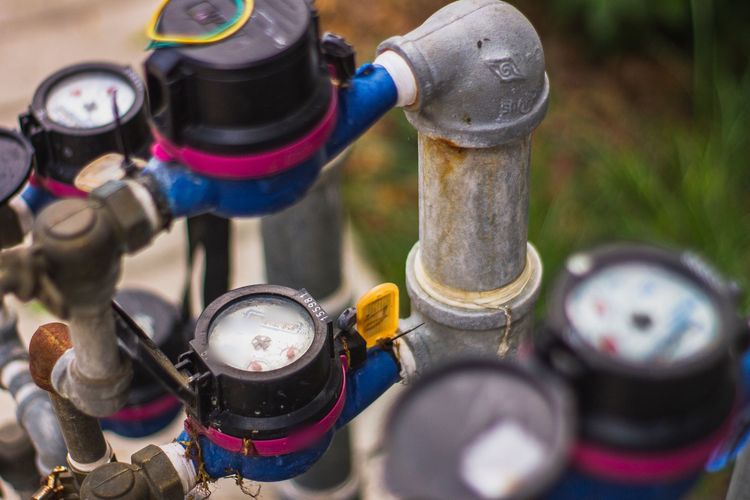
How a hidden leak is found
From the meter outwards: confirm it, narrow it down, then open up once.
Most hidden leaks show on the account before they show on a wall. A water meter that keeps moving with every tap closed is the first proof, and Tshwane publishes a simple meter test for exactly this, set out below.
From there the system is split up: the pipe from the meter to the house, the cold supply inside, the geyser and its overflow, the toilets. Closing valves one section at a time narrows it down. Listening equipment, thermal imaging and pressure testing then point to the spot, and only that spot is opened.
Toilets that run on and overflows that drip are leaks you can often see or hear. Leaks underground between the meter and the house are the costly ones, because the water soaks away and the bill is the only sign.
Every litre after the meter is on your account
Tshwane's rules put the cost of a hidden leak on the owner, and the ground north of the ridge does not help.
15 minHow long Tshwane's own meter test runs: read the meter, wait with every tap closed, read it again
The Water Supply By-laws are blunt. A customer is not entitled to a reduction for water lost in their own installation (section 26), and an owner may not allow a pipe or fitting to leak (section 55). From the outlet of the meter onwards, every lost litre is billed to you.
At 2026 rates that adds up fast. Above the free 9 kilolitres a month, Tshwane charges from R36.01 to R64.26 a kilolitre on a rising scale, and because the sewer charge is worked out from the water you use, a hidden leak pushes the sanitation charge up too.
The ground adds to it. North of the Magaliesberg the geology changes: the 1977 Geological Survey of the Pretoria area describes black 'turf' soil over the Bushveld rocks of the northern parts, and a clay tested at Onderstepoort, right next to Pretoria North, shrank by about a fifth as it dried. The CSIR's guide to pipeline design singles out heaving clay soils as needing particular attention. Ground that swells and shrinks with the seasons works at buried joints.
Out in the street the City has its own losses: 39.1% of Tshwane's water went unbilled in 2024/25, mostly through leaks it puts down partly to ageing pipes and high pressure. Your side starts at the meter, and so does the search.
The test below costs nothing. Tshwane notes that it only proves larger leaks, so a meter that creeps slowly is still worth a closer look.
Close every tap and check nothing is filling, such as a toilet cistern or the pool.
Read the meter then use no water for fifteen minutes.
Read it again. If the numbers moved, water is going somewhere.
Run the test tonight. If the meter moved, send a request with the two readings.
Source: Tshwane Water Supply By-laws, 2014 · City of Tshwane, 2026/27 tariffs, 2 July 2026 · City of Tshwane, checking for leaks, 17 October 2024 · Geological Survey, Geology of the Pretoria area, 1977 · Ofer and Blight, swelling clay at Onderstepoort, 1985 · CSIR Red Book, water supply chapter · City of Tshwane annual report 2024/25
Leak detection cardFrom the meter, back to the meter
Meter test
Readings with every tap closed, before and after, written on the card.
Located
Section isolated and the point found before anything is opened, with the method noted.
Opening
One opening, as small as the repair allows, agreed with you before it is made.
Repair
The damaged section replaced with new pipe in full lengths, not patched with offcuts.
Proof
Meter still with taps closed, photos of the leak and the repair, invoice detail for a Tshwane claim.
Making good the floor or paving is priced on its own line, so you know the cost before the hole is made.
Found first, opened once, closed properly
Leak hunts go wrong when the breaking starts before the finding is finished.
A leak is cheapest to fix when the finding is finished before the breaking starts: one opening, in the right place, made good afterwards.
The meter starts the job and ends it, with both readings written down.
The plumber behind Noord Plumbing has eight years of plumbing work in Pretoria North.
From a high bill to a still meter
The meter starts the job, and the meter ends it.
Read the meter
Fifteen minutes with every tap closed. Put both readings in the request if you have them.
Narrow it down
Supply line, house, geyser and toilets isolated in turn until the leak is in one section.
Pinpoint and repair
The spot found, one opening made, the pipe repaired.
Prove it on the meter
Taps closed, meter watched, photos taken, the opening closed and made good as agreed.
Leak detection questions
Asked by people staring at a water account.
How much does leak detection cost in Pretoria North?
Procompare's recent estimates for Pretoria North put water leak detection at about R1,200 for a single leak and R2,800 for a search across several points. The repair is separate and depends on where the leak is. You get the detection price before the visit, and the repair price before any opening is made.
Will Tshwane refund my water bill for a leak?
Rarely. The City's relief covers one kind of leak only, hidden underground between the meter and the house, and pays back at most R1,000 towards the repair and R2,000 towards the water, once a year per event. Geysers, toilets and leaks inside walls do not count. Keep the plumber's invoice and photos: the claim also needs a sketch of the leak's position and an affidavit.
My meter only moves a little. Is that still a leak?
It can be. Tshwane's own note on its meter test says it only proves larger leaks. A slow creep is often a toilet running on into the bowl or a small drip at a valve, which is cheaper to find. Watch the meter's smallest dial or red pointer: if it moves with every tap closed, something is using water.
Do you have to break tiles to find a leak?
Not to find it. Isolating sections, listening equipment and thermal imaging locate a leak without breaking anything. The repair usually needs one opening at the leak, and its size and the making good are agreed before it is made.
Why is my water bill high when I cannot see a leak?
Either water is escaping where you cannot see it, usually underground between the meter and the house, or the bill itself has changed: an estimated reading, a new tariff, or a faulty meter. The meter test tells you which. If the meter stands still with every tap closed, query the account before paying for a leak search.
Can a leak be under my floor slab?
Yes. Pipes that run under a slab can leak out of sight, and the first signs are often warm or damp patches, lifting tiles or the sound of running water. They are traced the same way, and sometimes the better repair is a rerouted pipe rather than an opened floor.
Request a call-out
Tell us the job and leave a number, and the plumber calls you to talk it through.
Water where it should not be? Turn it off at the meter now. It is the cheapest part of any repair.
Pretoria North and the suburbs around it
From the Apies River west to Rosslyn, and from Onderstepoort down to the foot of the Magaliesberg.
North
Wolmer, Onderstepoort, Bon Accord, Hesteapark, Clarina, The Orchards, Klerksoord
East
Annlin, Wonderboom, Sinoville, Magalieskruin, Montana, Montana Park, Doornpoort
South
Mountain View, Park Town Estate, Mayville, Wonderboom South
West
Dorandia, Florauna, Tileba, Theresapark, Ninapark, Karenpark, Amandasig, Akasia, Chantelle, Rosslyn
Not sure your suburb is covered? Send the request anyway and say where you are.